


Table of Contents
- How Are Headaches and Neck Pain Related?
- Tips for Relieving Headaches Caused by Neck Pain
- When to See a Pain Doctor?
- Long-Term Management Through a Healthy Lifestyle
Most people will experience tight neck muscles and headaches at various times, due to muscle strain or stress. Cervicogenic headaches are also common and are caused by referred pain from the neck’s vertebrae. The good news is that relieving a headache caused by neck pain is often possible with simple steps, such as massaging the neck and applying heat and cold compresses.
How Are Headaches and Neck Pain Related?
Headaches and neck pain are connected because the neck’s structures are connected to the nerve pathways in the head. The neck section of the spine consists of seven cervical vertebrae that protect the spinal cord and the muscles and support the skull.
The nerves in the neck and head share a pathway called the trigeminocervical complex (TCC). This complex combines pain signals from the trigeminal nerve in the face and from cervical nerves. When there is a problem in the neck, such as muscle tension or strain, these signals can be transmitted to the head, leading to a headache.
A stiff neck and headache are also commonly experienced together. A stiff neck is a tightness in the neck muscles due to muscle strain. The neck is stiff and can be painful to move.
There are four different types of headaches associated with neck pain. Each has its own unique characteristics.

1. Cervicogenic headache
This is a common headache that begins with pain in the neck’s bones or soft tissues. The headache usually starts after neck movement, especially when the range of motion is reduced. The cervicogenic headache is believed to be referred pain from the upper three (C1-C3) cervical vertebrae’s spinal nerves.
2. Tension headache
This is a common headache mainly caused by neck muscle tension, stress, or poor posture. A tension headache from neck issues is believed to result from sensitivity in the trigeminal nerve system and neck and muscle contractions.
3. Migraine
Neck pain is a symptom of a migraine, and it is also a predictor of a migraine about to begin. Researchers found that 89% of people with migraine also have neck pain. There is much more research needed in this area because a migraine does not necessarily indicate a neck bone, muscle, ligament, or tendon condition.
4. Occipital neuralgia
The occipital nerve begins in the neck’s C2 and C3 spinal bones. The nerve provides sensation to the back of the neck, the head, and the scalp. An uncommon condition, occipital neuralgia is a headache disorder that has symptoms that include severe, stabbing, or shooting pain. The pain may spread from the upper neck and the back of the head to behind the eyes and ears, and to the sides of the head. It can develop due to a pinched nerve in the neck, tight neck muscles, trauma, disease, or infection.
Tips for Relieving Headaches Caused by Neck Pain
Finding neck pain headache relief is frequently possible through a self-treatment plan. The following are 12 suggestions that may help. A good approach is to blend as many of the following as needed to find relief.
1. Apply heat
Applying heat to the back of the neck every two hours may open up constricted blood vessels that are causing a headache. Limit the heat application to 15 minutes at a time.
2. Apply cold
Applying cold packs to the neck, forehead, or temples every 2 hours can reduce blood flow. This may reduce inflammation and muscle spasms that are causing headaches. Limit cold applications to 15 minutes.
3. Self-massage
Using the fingertips, massage the back of the head or neck, forehead, or temples. Apply firm, gentle pressure to relieve muscle tension and strain.
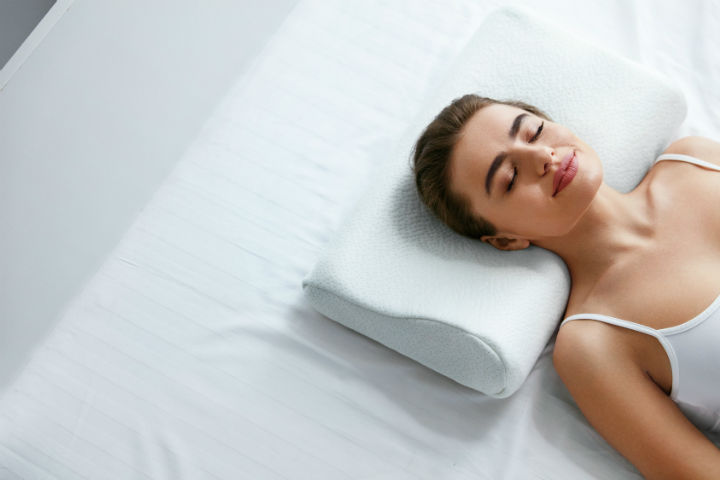
4. Sleep on a suitable pillow
A pillow should accommodate your favorite sleeping position and support the neck. It should also support spinal alignment.
5. Avoid oversleeping
Oversleeping can cause headaches due to neck strain. Sleeping in one position for an extended period can lead to tense, stiff neck muscles.
6. Maintain good posture
Maintaining good posture and spinal alignment throughout the day and at night is crucial to preventing neck strain and headaches. Slouching at a desk will strain neck muscles, ligaments, and tendons, leading to tension headaches. Good posture is vital at all times, whether sitting, standing, walking, or lifting objects.

Read the post “How to Straighten Your Back and Correct Spine Posture“
7. Wear shoes that keep the spine in alignment
The shoe choice should keep the back, including the neck, in alignment. High heels and poor arch support are common causes of spine misalignment and affect walking gait. A strain is placed on the entire back, including the neck. Wear low-heeled shoes with good arch support. Yes, avoid high heels.
8. Do gentle neck exercises
Gentle neck exercises like stretching, yoga, and walking can relieve a neck tension headache. Low-impact exercises are best because they calm the body while strengthening muscles.
9. Take over-the-counter pain relievers
There are over-the-counter drugs that may help reduce neck inflammation or swelling. NSAIDs inhibit the COX enzymes that cause inflammation. Reducing the inflammation may alleviate headache pain.
10. Stay hydrated
Muscles and spinal discs need to stay hydrated. Dehydration can lead to tightness in the neck, muscles, ligaments, and tendons. Staying hydrated also keeps spinal discs flexible and prevents shrinking.

11. Reduce stress
Stress can tense neck muscles, leading to pain and stiffness. Stress hormones such as adrenaline and cortisol are to blame. When experiencing ongoing stress, the neck muscles frequently tighten and relax, which can lead to inflammation and excessive nerve activity. Practicing relaxation techniques like deep breathing and making lifestyle improvements to reduce daily stress can lead to less neck muscle tension and fewer related headaches.
12. Physical therapy
Physical therapy can serve two purposes. One is that it may help strengthen weak neck muscles and other tissues needed for good posture and neck functioning. It can also relieve neck tension, helping to reduce headache pain.
When to See a Pain Doctor?
Many times, you can find headache relief caused by neck pain with self-treatments or physical therapy. However, if the pain persists, radiates, or is accompanied by other symptoms such as vision issues, fever, or muscle weakness, it is critical to see a pain doctor right away. If you think you injured your neck in an accident, see a doctor right away.
Neck pain that causes a headache may be due to something more serious than muscle tension, such as a herniated cervical disc or a compressed nerve. Also, a pain doctor can offer treatment plans for more complex conditions, like neck pain causing migraine headaches.
Long-Term Management Through a Healthy Lifestyle
In many cases, taking simple steps at home can help control a headache caused by neck pain. However, learning preventative steps is a good plan to avoid developing neck pain. Long-term management strategies include regular exercise, effective stress management, and maintaining good posture.
Sources
- https://www.ncbi.nlm.nih.gov/books/NBK507862/
- https://www.ncbi.nlm.nih.gov/sites/books/NBK562274/
- https://americanmigrainefoundation.org/resource-library/neck-pain-migraine/
- https://www.ncbi.nlm.nih.gov/books/NBK538281/
- https://www.health.harvard.edu/pain/occipital-neuralgia-symptoms-and-treatments